By Gilbert Falso :: 8:46 PM
 If you heard rumors over the weekend that T-Mobile was making big changes, those rumors were true. The wireless service provider will be ending contracts and subsidies for phone purchases beginning tomorrow.
The move away from phone subsidies, the ability to pay less for your phone up-front by signing into a long-term contract, is a new phenomenon in the U.S. cellular phone marketplace. T-Mobile is the first U.S. carrier to end phone subsidies.
T-Mobile customers will now be required to pay full price for their device if they buy it through the network. That price can be spread out in installments, or be paid in one lump sum. In addition, T-Mobile will allow customers to bring their own device to the network and simply pay for the service plan.
New plans begin at $50 per month for one line, $30 for a second line and $10 for additional lines after the second. The plans come with unlimited minutes for talk, unlimited texting and 500 megabytes of high-speed data.
Users can pay $10 per a month for an additional 2 gigabytes of high-speed data, or $20 a month for unlimited high-speed data on a per-line basis.
The company will unveil these plans in more detail at a press event tomorrow. In addition to the new plans, T-Mobile is also expected to announce their version of the iPhone as well as the release of the the BlackBerry Z10 for their network.
By Cynthia Herbert :: 7:11 PM
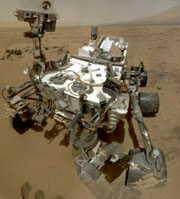 NASA’s rover on the red planet, Curiosity, has resumed normal daily operations after a computer error switched the craft into a safe mode back at the end of February.
Engineers at the space agency’s Jet Propulsion Laboratory (JPL) put Curiosity under the control of a second, backup computer due to a memory glitch. Since bringing the rover back online, it has been monitoring the Martian weather, and conducted laboratory analysis on powder obtained from drilling into a rock on March 23rd.
“We are back to full science operations,” said Curiosity’s Deputy Project Manager at JPL, Jim Erickson.
Like most NASA spacecraft, Curiosity is outfitted with two computers, engineered to be redundant to each other. Each of the computers, known as A-side and B-side, also has other redundant subsystems linked to only that computer. Curiosity is now operating on the B-side system, as it did during part of the flight from Earth to Mars. The A-side was recently used starting a few weeks before landing and continuing until Feb. 28th, when JPL switched over to the B-side in response to a memory glitch on the A-side. The A-side now is available to serve as a backup if needed.
By Paul Thomson :: 1:56 PM
 LinkedIn today announced that it will be introducing a number of improvements to its site search features that will bring it in line with what users expect, as search capabilities improve across the web and social media sites.
The new features include functionality already common across the web, like auto-complete, save-able search queries and suggested search words, and also some more robust updates like an algorithm that learns your queries over time and helps to better understand what (and who) you are looking for.
LinkedIn’s search updates come on the heels of recent large-scale changes by Facebook when it introduced its Graph Search capability earlier this year. Heavy users of social media sites expect search functions to be relatively similar across the networks, and this update from LinkedIn is timely in that it brings the business social network up to the level of Facebook, Twitter and Google.
Jonathan Podemsky outlined the thinking behind some of the more robust search enhancements on LinkedIn’s blog earlier today. “LinkedIn’s search efforts are founded on the ability to take into account who you are, who you know, and what your network is doing to help you find what you’re looking for,” he wrote. “We’ll continue iterating on this with better ways to surface new kinds of content across Linkedin as well as more personalized results.”
Below, screen shots from LinkedIn’s presentation on the new search features:
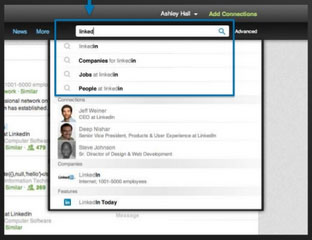
Auto-complete queries and suggested search terms.

Restrict the networks and parts of LinkedIn that you search.
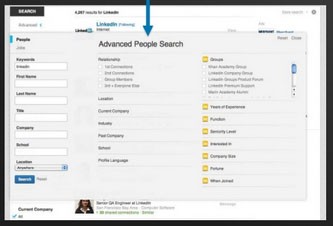
Filters allow for easier advanced searches
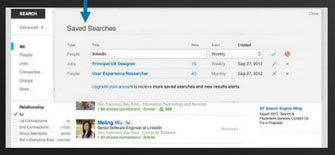
Automated alerts will save search queries and e-mail results when new matches appear
By Cynthia Herbert :: 12:27 PM
 The Federal Aviation Administration (FAA) may be getting ready to evaluate and change rules about using certain electronic devices on board commercial airliners during takeoff and landing.
Currently, use of iPads, Kindles, Nooks, and other e-reader devices are not permitted during takeoff and landing. According to sources who are part of the industry working group that the FAA pulled together to study the use of portable electronics on board, the regulatory agency hopes to put new rules in place by the end of the year that allow for reading devices. Cellphone use is not included in these rule changes.
The industry working group is comprised of members from a number of industries, including Amazon, the Consumer Electronics Association, Boeing, the Association of Flight Attendants, the Federal Communications Commission and aircraft manufacturers. The group will make its final recommendations to the FAA by the end of July.
With the advent of more wearable computing devices, like Apple’s proposed iWatch, and Google’s Glass product, the issue of what electronics can be used when on a flight will be more pressing, and the FAA’s working group has been charged to examine the problem from the standpoint of today’s technology as well as considering what future portable electronic devices are in the pipeline.
By Paul Thomson :: 6:43 AM
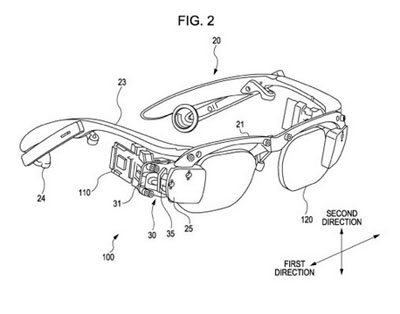
 A patent filed recently by Sony shows that the electronics company may be getting ready to compete with Google and its Google Glass product in the wearable eyeglass technology arena.
Patent application no. 20130069850 was filed by Sony in November, and published on the U.S. Patent & Trademark Office’s website on March 21st. It outlines a head-mounted display apparatus that allows the wearer to view the display out of both eyes, compared to Google Glass, which only allows one eye to view the display.
The most recent patent is a continuation of patent filings undertaken by Sony in 2008 and 2009.
A prototype sketch of Sony’s wearable device shows adjustable lenses and earbuds mounted on the arms of the glasses-like contraption – see below for drawing from the patent filing.
Sony has not yet made any announcement about wearable glasses-like devices.