By Gilbert Falso :: 2:03 PM
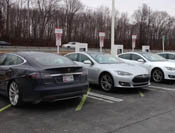 By now, you’ve probably heard about the saga of the New York Times’ journalist and the Tesla electric car trip and review gone awry. In summary, NYT writer John Broder took a Tesla Model S automobile for a trip from Maryland to Connecticut, and wrote a scathing review of the car when it didn’t perform as he had expected it would.
Tesla Motors CEO Elon Musk cried foul, and took to the Internet, social media, and traditional media outlets to rake Broder over the coals, and attempted to use data from the car’s sensors to back up his findings. Things turned ugly for a while.
Now, seven Tesla owners are trying to set the record straight about their cars, and have hit the road and are Tweeting out data and information about their trip along the way from the Twitter account @TeslaRoadTrip.
Sensors on board the cars track everything from speed to battery levels to inside and outside temperature. As an example, here is one of the Tweets sent out by the car’s data connection: “meterreader22 is currently driving about 65 mph, battery level 58%, 141.31 miles range. #telemetry #TeslaRoadTrip.”
These seven drivers hope to show that Broder was incorrect in his article, and pushed the car to limits that most normal Tesla drivers would not take with an electric automobile that requires certain times and levels of charging before it can be expected to make such a drive.
By Paul Thomson :: 12:01 PM
 With everyone on a bit of a heightened alert for huge rocks falling from the sky since the large meteor crash in Russia on Friday, residents of the San Francisco area received a bit of a scare late last night.
Astronomers believe the a fireball seen in the skies over western California was due to a meteor.
Many people reported seeing a bright flash of light around 7:45 p.m. – it apparently could be seen in Santa Rosa, Calif., as well as the nearby cities of San Jose and Morgan Hill.
It was bright green and then turned to yellow as it came closer to the ground, according to a witness posting on the Facebook page of a San Francisco-area television station.
Experts think that the object was a “sporadic meteor.” These rocks impact the Earth many times a day and can rain down 15,000 tons of space debris per year on Earth.
There is no connection known between the California meteorite, and the meteorite that struck Russia on Friday.
Below, see a video of the California meteor, taken from the dashboard camera of a car on a nearby highway:
By Gilbert Falso :: 11:39 AM
 Just like Apple has its flagship storefronts, it looks like Google will now, too. Some sources have told major publications that the search giant is in the process of constructing a chain of stand-alone retail stores across the U.S. and should have its first location up and running in a major metropolitan area in time for the holiday season.
Google will use the stores to showcase its Nexus and Chrome line of products, and make it easier for customers to see, hold, and play with the devices. At this time, it is not particularly easy for potential customers to have a hands-on experience with Google hardware products before they buy them. Competitors Apple and Microsoft both have retail storefronts where customers can try things out and play with them before they buy.
Although the idea of a stand-alone retail store for Google is now, this is not Google’s first presence in the retail marketplace. Currently, Google has some Chrome areas within the retail chain Best Buy in the U.S. and PCWorld/Dixon’s in the U.K. However, the individual retailer handles the end transaction in these cases, and not Google. In the store-within-a-store model, Google has trained employees to showcase their products and answer questions.
With Google Glass, Google’s wearable glasses display interface product, this could be a good outlet – as the devices are thought to be pricey when the hit the market (between $500 and $1000), many people will want to experiment to see the value before plunking down that much cash for a new product.
It is also thought that Google will use the storefronts to sell Google-themed merchandise like t-shirts and other assorted tchotkes with the Google name on them.
By Gilbert Falso :: 5:28 AM
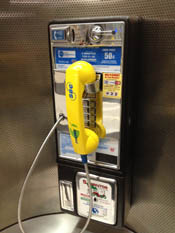 The venerable payphone is on its way to the history books in most places these days. Once numbering in the millions across the United States, estimates from the Federal Communications Commission and the communication industry recently put the number of pay telephones left in America between 250,000 and 400,000.
In New York City, the city government has put together a contest to redesign New York’s payphones before the current vendor contract expires in 2014. The goal is to create a public telephone that will make the city more accessible, safer, healthier, greener and better informed, and the contest has been dubbed the Reinvent Payphones Design Challenge.
Teams who have entered the contest have to submit information about their prototype design for consideration by February 18. Fifteen semifinalists will be asked to present their ideas at the Reinvent Payphones Demo Day on March 5, where they will compete for three prizes. Then, the top three winners will be featured on the City of New York’s Facebook page, and their ideas will be put forward for a public vote.
Judges will look for the following criteria from design teams:
- Connectivity: The ability to connect New Yorkers and enable communication, including safety and emergency uses
- Creativity: Originality, innovation and quality of the idea
- Visual Design: Visual appearance and user interface experience
- Functionality: Flexibility, versatility, scalability, accessibility and sustainability
- Community Impact: Support of community residents, businesses and cultural institutions
New York city has partnered with several start-ups and educational institutions to work on the contest project. Entrants who have their design ideas chosen to move to the next level will be  notified by email by February 22.
Â
By Cynthia Herbert :: 2:14 AM
 Late last year, when Apple ditched Google as its provider of maps and map data and launched its own version of mapping software for its mobile operating system, it quickly crashed and burned with users across the world. Simple searches for well-known roads, landmarks and businesses no longer worked. Point-to-point directions were getting people lost, and into dangerous situations.
Once Google finally made a maps app available late last year, many users switched over and left the faulty Apple Maps in the dust. But not the government and fire departments of Victoria Australia.
The Victorian government has an iOS app called FireReady that relies on data from Apple Maps to provide information to residents. The app is supposed to help residents get information about area wild fires, and determine accurate and safe escape routes from them.
An Australian Country Fire Authority spokesperson told the Sydney Morning Herald newspaper that the resulting situation make it “difficult to quickly determine the exact location of fires once alarm calls are being received. “ He explained that this is currently creating dangerous situations and delays to activate phone trees among residents if needed.
370,000 Australians have downloaded the app, and expect it to work in the case of a wildfire or similar emergency.
The mapping software provided by Apple doesn’t properly display the names of cities and towns, and so far, Apple has not been very responsive to the County Fire Authority’s requests for help.
With all the known issues with Apple Maps, it is surprising that the government chose to employ such a solution, but the government spokesperson told the Herald that they were “forced to use Apple Maps.†He explained, “when apps get integrated into an iPhone, they connect up to the native Maps App. In the Yelp app, for example, the “open Maps app” widget directs to Apple Maps, even if Google or Nokia’s are installed on the phone. That’s just the way it works. When looking for restaurants, it’s not such a big deal. When trying to warn people about fires, however, we’d go with Google.â€
[FireReady app info]