By Gilbert Falso :: 1:37 AM
 Christopher Dorner, the quadruple murderer who took his own life while barricaded in a cabin after a shootout in the mountains outside of Los Angeles last week, has been portrayed as a hero in a sick video game that is making the rounds of the Internet.
The shooting-style video game is called “Chris Dorner’s Last Stand: A True American Hero”, and starts off with Dorner in a cabin, ready to shoot out the windows at law enforcement officers surrounding the building. Dorner’s character is armed with an assault rifle.
In addition to the violent anti-cop sentiment, the game is also filled with racist language and undertones.
The game was allegedly created by a user who posts on the Internet message board 4Chan.
A video trailer for the game has been posted on YouTube, the link is below. Be warned that it is extremely graphic and disturbing, and includes a soundtrack with gunshots and foul language.
By Paul Thomson :: 12:59 AM
 All-new research released this week by J.D. Power and Associates finds a link between social media and business metrics such as consumers’ likelihood to purchase or interact with companies through social media channels,
The 2013 Social Media Benchmark Study is based on responses from more than 23,200 U.S. online consumers who have interacted with a company via the companies’ social media channel. Run late last year, the study measures the overall consumer experience in engaging with companies through their social platforms for both marketing and servicing needs across more than 100 U.S. brands in six industries: airline, automobile, banking, credit card, telecommunications and utility. The study establishes performance benchmarks and industry best practices that provide insights to companies to help them maximize their social media efforts.
“This is a unique, comprehensive consumer study that defines consumer expectations in the ever-changing social space and measures companies’ performances against those benchmarks,” said Jacqueline Anderson , director of social media and text analytics at J.D. Power and Associates. “This study provides companies with the framework they need to begin effectively integrating social media into their business strategies. It also illustrates the relationship between a positive social media experience and consumer purchase intent.”
The study focuses on two types of social media engagements, marketing and servicing, and provides best practices for each. Marketing engagements include connecting with consumers to build brand awareness and affinity, in addition to promoting coupons and deals. Servicing engagements include answering specific consumer questions or resolving problems.
J.D. Power found that social marketing engagements vary by age group. Nearly one-third of consumers 30-49 years old and 38 percent of those 50 years and older interact with a company in a social marketing engagement context, while only 23 percent of consumers who are 18-29 years old interact with companies. In contrast, 43 percent of consumers who are 18-29 years old use social media for servicing interactions, while 39 percent of consumers who are 30-49 years old use social for servicing needs. Only 18 percent of consumers who are 50 years and older interact with a company via social for a service-related need.
The study finds a correlation between overall satisfaction with a company’s social marketing efforts and consumers’ likelihood to purchase and their overall perception of the company. Among highly-satisfied consumers (satisfaction scores of 951 and higher on a 1,000-point scale), 87 percent indicate that the online social interaction with the company “positively impacted” their likelihood to purchase from that company. Conversely, among consumers who are less satisfied (scores less than 500), one in 10 consumers indicate that the interaction “negatively impacted” their likelihood to purchase from the company.
The study also found that some industries are more successful than others at implementing best practices into their social media engagement strategies than others. When looking across industries, the automobile industry performed particularly well in both marketing and servicing social media interactions, the only industry to do so. Other industries performing well are wireless in social servicing interactions and utility in social marketing interactions.
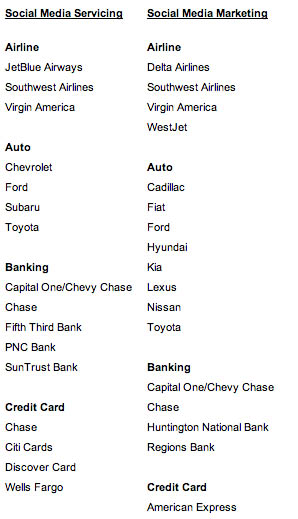
Listed below are some of the companies that perform particularly well in some of the industries included in the study:
By Gilbert Falso :: 11:03 PM
 European social media printing service Inkifi has launched a new program that will allow Instagram users to earn money through selling their Instagram images. Instagram photographers can turn their photographs into artwork and then sell it to the general public, and earn a commission on the sale.
Printing, shipping, handling and all other fulfillment duties are handled by by Inkifi. In addition to prints, the company can also print other items, including acrylic prisms, greeting cards, framed art, canvas prints, and T-shirts.
Photographers will still own and control all the rights to their work, and they will be able to track their level of sales and commission via an online account, and receive a dedicated gallery to feature and sell their work from.
[More info:Â Inkfi]
By Paul Thomson :: 8:46 PM
 When Sony acquired Gaikai, a company that specializes in streaming video games last year, many in the industry began speculating what that would mean for the upcoming PlayStation 4. Now, media reports are confirming that it is very likely that Sony will use the service to stream games to the new PS 4, set to be unveiled next week.
The company won’t be streaming new games to the next generation console, however – those will still be purchased via optical disc. Instead, Sony will leverage Gaikai technology to stream existing PlayStation 3 games
It’s been a busy week for the PS 4 rumor mill. A few days ago, a picture (see above) popped up online, and has since gained much credibility as being a legitimate picture of the upcoming controller for the PS4.  It appears to be a DualShock-type controller witha touchpad along the top, and a blue light on the back. The blue light looks very much like the kind on the back of the PlayStation Move motion controller.
All this rumoring and guessing will end next week, however, as Sony is set to debut the new console on February 20.
By Cynthia Herbert :: 4:29 PM
 “Facebook” and “hacked”. Two words that most of us don’t ever want to see put together, due to how much information and portions of our lives we’ve trusted the social network with.
But that’s exactly what happened late last month to the world’s largest social network, as it became the victim of a sophisticated attack through Java software, known as a zero-day bug. A zero-day bug is a type of malicious attack that can exploit a previously unknown vulnerability in a computer software application – meaning that the attack occured on “day zero” of awareness of the software’s vulnerability to attack.
In this case, some Facebook developers had their company-issued computers infected after they had visited a third-party mobile developer website. Unbeknownst to the Facebook employees, hackers had compromised the developer website and installed malicious code that could exploit a security hole in the Java plugin of their web browsers. The exploit was then able to install some malware programs onto the Facebook employee computers.
Facebook released a statement about the incident, saying that the attack did not expose any Facebook user data, and it was contained only to the laptops of a small number of Facebook developers.
In general, Facebook has been very public and forthcoming about the hacking attempt, and how it handled the aftermath. The attack occurred within the same timeframe as the exploit that exposed  passwords on Twitter. While Twitter was not as publicly open about how that attack happened or how it was discovered, it did mention a Java browser plugin exploit, and urged users to disable Java functionality in their browsers.