By Katherine McClosky :: 6:43 AM
 Borrowing a page (excuse the pun) from services like Instapaper, Amazon yesterday introduced “Send to Kindle” functionality that allows Kindle device
The “Send to Kindle” feature will allow users to read web content offline on their devices at their leisure, and works from a variety of sources. Most users will probably take advantage of the new functionality by installing browser extensions for Chrome or Firefox – the easiest way to send web content.
In addition to the browser extensions, Amazon has also created programs for both Windows and Mac operating systems for sending personal and business documents to your Kindle, and has set up the capability for you to e-mail content to your Kindle.
Mobile support for the “Send to Kindle” feature is currently limited to the Android operating system.
On the flip side, content owners and webmasters now have the ability to add “Send to Kindle” programming and buttons to their sites to make it easier for readers to view their content offline later.
“The Send to Kindle Button lets people easily send that content to their Kindle so they can it read later,” Amazon said in a release. “No more hunting around for that website or blog that caught your eye – just open your Kindle and all the content you sent is right there.”
Amazon’s new feature is one of two content storage and curation services to launch yesterday. The other is Google Keep, Google’s Evernote competitor that allows for storage and organizations of documents in the cloud, synched across multiple devices through Google’s Google Drive cloud storage product.
[More: Send to Kindle
By Paul Thomson :: 9:37 PM
 The U.S. Department of Defense is all but set to dump the BlackBerry as its smartphone of choice and move to Apple’s iPhone, sources close to the Pentagon tell several news outlets.
Those involved believe that the government is about to order roughly 650,000 Apple mobile devices to replace the fleet of BlackBerry phones currently in use across military units. The tally is thought to be 210,000 iPhones, 200,000 iPods, 120,000 iPads and 100,000 iPad minis – all replacing various BlackBerry devices that had been used for years.
This is the second recent blow today to BlackBerry from a government entity. Earlier in the day, a UK news outlet reported that BlackBerry’s new flagship handset, the Z10, was not secure enough for use by the British government.
The UK government’s Communications and Electronics Security Group apparently rejected the Z10 because the operating system had failed security requirements and tests that earlier versions of the BlackBerry operating system had passed. Sources close to the UK reviewers claim that the issues were related to the BlackBerry Balance feature, software that separates the phone into a “work” and “personal” set of zones.
By Paul Thomson :: 5:50 PM
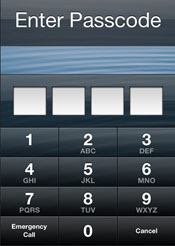 It’s the case of the medicine being worse than the affliction. The new Apple mobile operating system patch, iOS 6.1.3, that was supposed to address issues with the lock screen being easily compromised, instead introduced new ways to bypass the security when the initial problem was fixed.
Now, a new password bypass glitch has been uncovered. Using just a paperclip and good timing, the screen lock password can be bypassed by ejecting the SIM card from its port as the iPhone begins dialing a phone number via Voice Control.
Once the phone application has been unlocked this way, recent call logs, contacts, and voicemail are all wide open, as well as photos and videos (accessed by creating a new contact).
Independent tests have verified that this hack works on the iPhone 4, 4s, and 5. To ensure that your phone is not open to this hack if you have already installed iOS 6.1.3, you’ll need to go to Settings > General > Passcode Lock. Under Passcode Lock, you can disable Voice Dial on the iPhone 4, or enable Siri (which replaces Voice Control) on the iPhone 4s and above.
By Paul Thomson :: 11:26 AM
 Google’s fiber optic super high-speed internet service, Google Fiber, will soon be expanding outside of its initial test city of Kansas City to nearby Olathe, Kansas, the fifth largest city in the state with a population of about 125,000.
Yesterday, Olathe’s city council voted to approve a resolution that brings the fiber optic service into the city, setting plans in place for Google to roll out the design and engineering phase of the gigabit Internet service.
There is much planning work that needs to be done before Olathe will be online, but Google will release details about network construction and how residents can register for the service soon.
The company released the following statement about the expansion of Fiber to the city, “Olathe has become one of the fastest-growing cities in Kansas and has attracted an influx of new businesses and residents. They’ve all noticed what a great community Olathe is, and so have we.”
In November, Google began connecting residents and businesses in Kansas City, Kansas, and Kansas City, Missouri to the high-speed network. Google’s Fiber service Internet connections speeds that are up to 100 times faster than what most U.S. homes have today, and Google is the fastest Internet service provider in the country, according to statistics compiled by Netflix last month.
By Gilbert Falso :: 11:07 PM
 Verizon wants to change the way we all watch television. The telecommunications company is hoping to ditch the old models for good with its new fiber optic FiOS delivery system, and allow customers to only subscribe to and pay for the television channels that they actually watch.
While the company isn’t quite at the à la carte level of pricing structure yet, it intends to disrupt the traditional pay television industry by measuring customer interest in channels, and counting unique monthly viewers. If no one tunes in to certain channels, Verizon will remove them from the FiOS lineup.
Unlike traditional television measurement methods, Verizon’s analytics will not make use of Nielsen ratings or Nielsen technology, but the company will instead use its own set-top box technology to measure and track what channels customers watch each month.
According to reports in the Wall Street Journal, Verizon has been has been in talks with several middle and smaller tier media companies about contracting for channels based on audience size and viewing habits. This would be a different model than existing arrangements for cable and satellite providers, who usually pay a monthly, per-subscriber fee for channels, regardless of the viewership.
Under Verizon’s plans, each channel would be compensated based on the number of FiOS subscribers that tuned in each month for a minimum of five minutes.
“If you are willing to give a channel five minutes of your time, the cash register would ring in favor of the programmer,” a Verizon spokesperson familiar with the negotiations told the Wall Street Journal.
One detail that isn’t likely to sit well with pay-TV customers however – FiOS subscribers’ cable bills aren’t likely to decrease under this new method. The shift might help to stabilize prices for consumers, according to Verizon, and keep those yearly rate increases in check, though.
FiOS television is the nation’s sixth-largest provider of pay television services, and boasts about 4 and a half million subscribers.