By Cynthia Herbert :: 11:48 PM
 If you’re a politician, you should probably be careful about what you “like” on Facebook. Just ask Charles Mainor, a Jersey City Assemblyman, who finds himself wrapped up in a big brouhaha over questionable Facebook pages he’s liked.
Constituents in Mainor’s district are pointing to one particular Facebook page, “Big Bootie Freaks.â€
Mainor told the New Jersey Journal newspaper that he believes that his constituents are “trying to discredit me in some kind of way because I agreed with the gun deals that I pushed through. We’re losing babies. And if the best they can do is come back and say, ‘He shouldn’t have Big Bootie Freaks,’ then I said, ‘Hey, you shouldn’t have guns.â€
The large posterior page, as well as one about fighting, have since been removed from the list of pages the politician likes. Mainor was first elected to the New Jersey General Assembly in 2009, and represents the 31st Legislative District, which includes the Hudson County municipalities of Bayonne and part of Jersey City.
By Paul Thomson :: 11:32 PM
 HTC will be announcing its new smartphone handset tomorrow, the HTC One. Here’s what we might expect to see and hear at the launch event.
Previously leaked rumors have us thinking that the HTC One will feature a 1.7GHz Qualcomm quad-core processor, with a 4.7-inch  full HD display with a resolution of 468ppi. 2GB of RAM and 32GB of internal storage under the hood, and dual front-facing stereo speakers.
The two cameras will likely be a 13-megapixel camera facing the rear, and a 2-megapixel front-facing camera. It will run the Android Jelly Bean OS. A sneaked press shot of the One shows that the handset may have an aluminum chassis with an overall stylish feel to it. Many who have seen the leaked images claim that it has a very similar feel to the iPhone 5.
All the guessing will end, and the rumors will be put to rest tomorrow at 11:00 am EST.
By Paul Thomson :: 5:36 PM
 A new study analyzing Twitter conversations pertaining to four major US retailers: Costco, Kroger, Safeway, and Walgreens. Entitled “A Day in the Life of Brands on Twitter†looked at nearly 12,000 tweets mentioning those four brands during a 24-hour period on January 8th, 2013. The study revealed that during that time frame, 37% of brand-associated tweets were customer service-related, while only 3% of tweets were tweeted directly at the retailers using an “@mention.â€
“Our research proves that there is an immense amount of conversation surrounding retailers on Twitter, and much of it consists of consumers voicing concern or requesting assistance with a variety of issues,†said to Liel Leibovitz, Assistant Professor of Communications at New York University, who conducted the study commissioned by Conversocial. “This might sound obvious, but our analysis provides a rarely-before-seen level of depth by looking at a day in the life of Twitter and analyzing a significant number of individual tweets.”
The brands followed in the study saw a total of 4,367 customer service-oriented tweets, an indicator of high demand for assistance via social channels. For example, roughly 23% of tweets surrounding Costco concerned products, while 18% of tweets discussing Kroger pertained to customer experience.
Study data found that the vast majority of tweets, 97%, made no reference to the brands’ Twitter handles and only contained the company’s name. As a result only 352 out of 11,732 customer messages about any of the four brands on Twitter were directly communicated. For every direct @mention received, another customer tweeted about real dissatisfaction with the retailer, presenting a significant opening for companies to reach out and address these real customer service issues. The huge volume of tweets about a company— more than 30 times the number of @mentions they receive— speaks to the fact that it is now essential for businesses to have the tools and expertise to filter through the noise and identify the tweets that require a response.
“A vast number of people are now turning to Twitter to engage in conversations about and with their favorite brands— presenting a huge opportunity for businesses to reach out to customers, efficiently identify conversations that need response, and prevent inquiries from escalating beyond repair,†said Conversocial’s CEO Joshua March. “The results of this study indicate that customer service-focused brands who can preemptively respond to customers, before they turn to more expensive customer service channels, will reap multiple benefits including increased ROI, brand protection, and reduced customer attrition rates.â€
[More info: Conversocial study]
By Gilbert Falso :: 12:29 PM
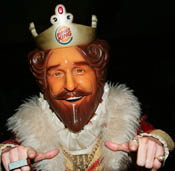 Hackers apparently gained access to the Burger King Twitter account this morning, making changes to the account profile, and Tweeting as the U.S. burger chain.
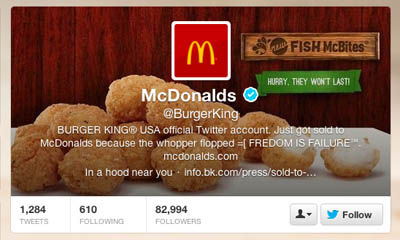
As of just after noon, the account displays the name of rival McDonald’s as its username, and claims that the chain was just sold to McDonald’s because the “whopper flopped.”
Update:Â A Tweet posted to the account at 12:38 PM seems to indicate that this was the work of online hacking group Anonymous: “Everybody follow us! @YourAnonNews #OpMadCow” and alludes to an Anonymous operation called “Mad Cow.” Some online are speculating this may have something to do with issues of horse meat found in European beef.
Update: For the most part, the general sentiment around the Internet and social media is one of light-hearted jest about Burger King’s situation. It may not be all bad – the hacked account has gained about 28,000 followers in the hour since it has been hacked.
Update:Â As of 1:15 pm, Twitter has suspended the compromised Burger King account.
Update:Â Burger King will apparently address the situation and apologize on their Facebook page. No timetable has been given for when this will happen.
Neither Twitter nor Burger King seem to have issued an official statement yet – but we are waiting to be filled in on details. This story will be updated as we learn more.
Below is a screen shot of how the account appeared right after it was hacked:
By Paul Thomson :: 7:19 AM
 After two meteorite incidents late last week, in Russia and San Francisco, this announcement seems to come at a perfect time. NASA has indicated that it will help back a University of Hawaii project to identify dangerous asteroids before they plunge to Earth.
Called ATLAS (Asteroid Terrestrial-Impact Last Alert System) the system will allow researchers to operate up to 8 small telescopes, each outfitted with cameras of up to 100 megapixels, on two locations in the Hawaiian Islands. The University’s team is on track to build and run an asteroid detection system that will patrol the visible sky twice each night looking for faint objects moving through space.
The University expects that the system will be fully operational by the end of 2015.
Astronomer and faculty member John Tonry compared ATLAS’s sensitivity to be similar to detecting a match flame in New York City when viewed from San Francisco.
The team believes that the system will be able to offer a one-week warning for a 50-yard diameter asteroid, and a three week warning for a 150 yard-diameter asteroid.
“That’s enough time to evacuate the area of people, take measures to protect buildings and other infrastructure, and be alert to a tsunami danger generated by ocean impacts,†explained Tonry.
Many asteroids reside in the main asteroid belt located between Mars and Jupiter, though some, called near-Earth objects, can orbit much closer to Earth.
ATLAS will complement another system searching for asteroids, the Pan-STARRS project, a system that searches for large “killer asteroids†years, decades, and even centuries before a potential impact with Earth. Pan-STARRS takes one full month to complete one sweep of the sky in a deep but narrow survey, compared to ATLAS which will search the sky in a closer and wider path to help identify smaller asteroids that could hit Earth much more frequently.
Funding from the Near Earth Observation Program at NASA will provide $5 million over five years with $3.5 million designated for design and construction during the first three years and the remainder for operating the system in the following two years.
[More info: ATLASÂ | Image above: conceptual rendering of ATLAS telescope]