By Cynthia Herbert :: 9:09 PM
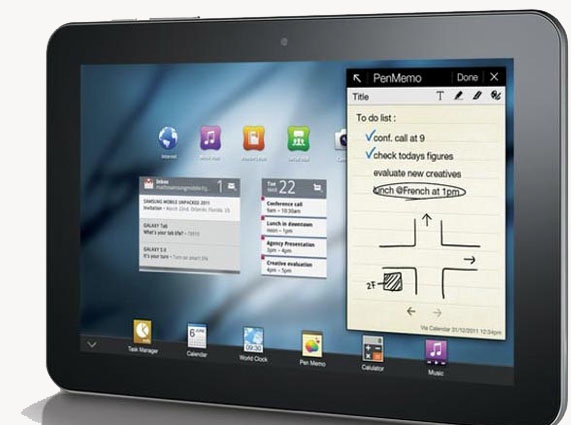 Samsung has unveiled its new 8.9-inch Galaxy tablet running Google’s Android 3.1 (Honeycomb) operating system, and announced that it will be available on October 2nd, along with two new media players, the Galaxy Player 4.0 and 5.0.
The Galaxy tablet comes in two models, 16GB priced at $469, and 32GB priced at $569. The Galaxy Player 4.0 will go on sale for $269 and the 5.0 will sell for $229.
“These 3 additions to the Galaxy family of products are impressive examples of our commitment to offering consumers an unrivaled array of choices for entertainment and information on-the-go,” said Dale Sohn, Samsung president of mobile technology.
The tablets can be pre-ordered at www.samsung.com beginning today, but the media players will not be available until tomorrow or Wednesday.
The Galaxy 8.9 tablet joins its larger sibling , the Galaxy 10.1 tablet in Samsung’s line of personal tablet offerings. The 8.9 is 8.6 millimeters thick, and weighs under one pound. The touchscreen display has a resolution of 1280-by-800 and sports Gorilla Glass.
Like with other Android devices, apps are downloaded through Google’s Android Marketplace, and the Galaxy comes with Samsung’s All-Share service for transferring content between the tablet and other devices like televisions, monitors, and digital cameras.
Under the hood, the new Galaxy tablet has a 1.5GHz, dual-core T205S central processor, a 6,100 mAh battery and two cameras—a rear-facing 3 MP camera and front-facing 2 MP camera.
By Gilbert Falso :: 8:42 PM
 We published this article last night about Facebook’s ability to track a user’s activity after they had logged off of the system. Facebook contacted us this afternoon to offer their side of the story. A statement from Facebook’s spokesperson is below:
Facebook does not track users across the web. Instead, we use cookies on social plugins to personalize content (e.g. Show you what your friends liked), to help maintain and improve what we do (e.g. Measure click-through rate), or for safety and security (e.g. Keeping underage kids from trying to signup with a different age). No information we receive when you see a social plugins is used to target ads, we delete or anonymize this information within 90 days, and we never sell your information.
Specific to logged out cookies, they are used for safety and protection, including identifying spammers and phishers, detecting when somebody unauthorized is trying to access your account, helping you get back into your account if you get hacked, disabling registration for a under-age users who try to re-register with a different birthdate, powering account security features such as 2nd factor login approvals and notification, and identifying shared computers to discourage the use of ‘keep me logged in’.
By Cynthia Herbert :: 5:18 AM
 As we get closer to October, rumors about the impending iPhone 5 launch are flying around Silicon Valley like crazy.
Reports are pointing to Apple planning for a media event on October 4th in Cupertino, California at the Town Hall Auditorium for the launch. This is a strange move, as the venue is much smaller than the one in San Francisco where iPhone 4 was launched.
AppleInsider is reporting that Apple has been quietly denying employees vacation leave during the second week of October, which suggest that this a possible window for the retail launch of the iPhone 5. Two sets of dates have been included in the no-vacation policy, October 9th – 12th which is when iOS 5 will likely launch, and October 14th – 15th which may represent the retail release of the next iPhone.
By Gilbert Falso :: 11:31 PM
 Update: Facebook has responded to our article.
Hacker Nik Cubrilovic has performed a series of tests analyzing the traffic and requests sent by browsers to Facebook, and has discovered that the social networking site alters its tracking cookies when users log out, instead of deleting them. Since a user’s unique account information is still held in Facebook’s tracking cookie, they can continue to track their whereabouts as they surf the Internet.
If a user then visits a website with a Facebook plug-in installed, such as the “Like” button, or a comment box, their browser will continue to send personally identifiable information about this visit back to Facebook.
According to Cubrilovic, “With my browser logged out of Facebook, whenever I visit any page with a Facebook like button, or share button, or any other widget, the information, including my account ID, is still being sent to Facebook. The only solution to Facebook not knowing who you are is to delete all Facebook cookies. You can test this for yourself using any browser with developer tools installed. It is all hidden in plain sight.”
If confirmed by Facebook, this is a serious violation of privacy and user expectations. Many people are already alarmed that Facebook’s new timeline and newsfeed will report what they are reading or listening to in real time, adding the media that users consume to their profiles without them clicking a “like†button.
By Gilbert Falso :: 9:16 PM
 Amazon has scheduled a press conference for this Wednesday in New York City. Analysts are speculating that the company will be announcing its new tablet device at the event.
This will be the end of the long string of rumors of Amazon working on a branded tablet to compete against Apple’s iPad line. It would be an addition to Amazon’s Kindle e-reader, which it offered for several years.
The new Amazon tablet is said to have a 7-inch color touch screen and will run on a customized Android operating system. There were sources that say the upcoming tablet will also be called Kindle.
Coming in with a price point close to $250, the tablet will be much more affordable than Apple’s iPad2. Amazon is doing this as a loss-leader launch – meaning that it will lose money on the hardware sale, but hopefully make it up with the sale of apps and ebooks and other software for the device. Part of the loss-leader strategy includes automatically signing up new customers for Amazon Prime, Amazon’s membership service. Movie, music, apps and software are all combined into one service provider at the lowest prices, and customers have no inclination to look elsewhere for such content.
Lately, Amazon has been beefing up its movie and TV show content for Prime members, and now it has streaming video that rivals subscription service Netflix. By bundling the Prime subscription with the tablet, the company can lower costs on its hardware, and gain a foothold in the climb against Apple’s iPad.
There is no cellular network service for this offering, it will be Wi-Fi only, and apparently nothing like other Android-based tablets on the market today. A TechCrunch report says that the user interface is customized by Amazon, with colors of black, blue, and copious amounts of orange. The main screen resembles iTunes’ Cover Flow for displaying all the content stored on the device.